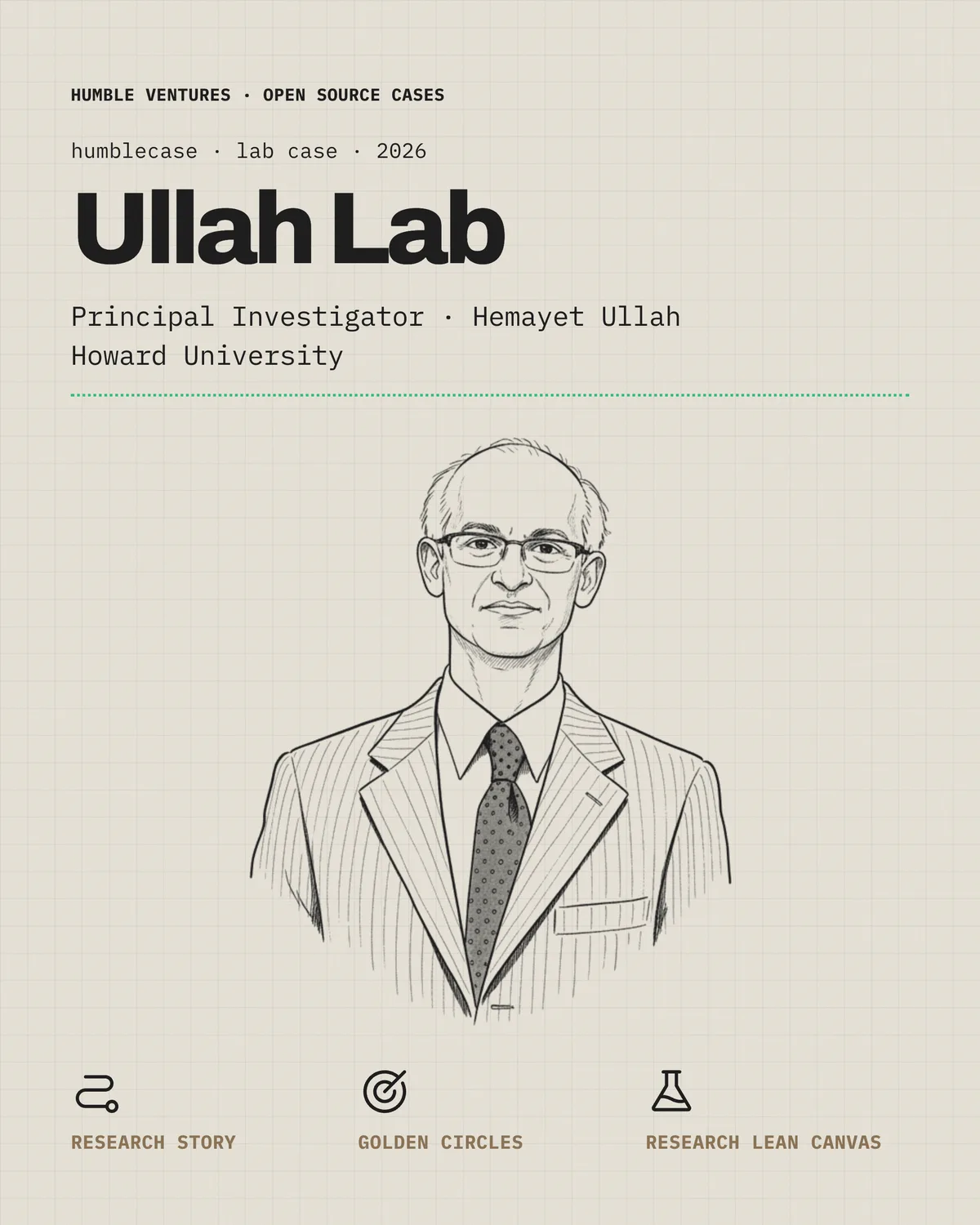
Ullah Lab
Principal Investigator: Hemayet Ullah
Hemayet Ullah has followed one question, how a cell's signalling hubs decide growth and stress, from plant G proteins at UNC to RACK1 at Howard, carrying it into crops, viruses and cancer, and into his students' research.
Welcome to the open-source case for Ullah Lab. Hemayet Ullah's story is worth the telling because of its throughline: a plant-science student who left the University of Dhaka for an MS at NC State and a PhD at UNC Chapel Hill has built a career on a single, stubborn question — how a cell's signalling hubs decide when to grow and how to withstand stress — and followed it from plant G proteins to their structural cousin RACK1. At Howard University, his lab is where that question lives now, probing how these hubs integrate growth and stress signals and whether molecules aimed at them can tune outcomes in crops, viral infection and cancer, all while bringing students into science. The Research Story traces how this PI and his central question came to be; the Golden Circle sets out why he does the work, how, and what it has produced — including the finding that the G-protein alpha subunit GPA1 positively modulates cell division (Science, 2001); and the Research Lean Canvas grounds it in a tangible problem, crops failing in salty soil, and the rice growers on salt-affected land who carry it.
The Problems, in Plain Words
- Keeping crops alive in salty soilSalty soil makes rice leaves yellow early and cuts harvests, a problem that grows as the climate changes. Ullah studies RACK1, a protein that works like a switchboard for a plant's stress and growth signals. In rice, boosting RACK1B kept leaves green under salt by slowing chlorophyll breakdown; in Arabidopsis, losing RACK1A left plants salt-sensitive. He has also made small molecules that turn the switchboard up or down; one boosted root growth and could become a root-inducing bio-stimulant for growers.s18s41s22s4s9s11
- Stopping viruses that hijack our cellsMany viruses copy themselves by borrowing a protein from the cells they infect, RACK1, to read their own genetic instructions. Ullah solved the first 3D structure of a RACK1 protein and, with Georgetown chemists, designed small molecules that fit its working spot. In lab-grown cells they stopped herpes simplex virus about as well as the standard drug acyclovir, and worked better alongside it. In a later preprint, the same compounds cut HIV-1 and hepatitis C reporter activity and reduced HIV protein production in infected cells. It is like changing the lock on a tool the burglar needs instead of chasing the burglar: aiming at the host protein rather than the fast-changing virus is why the approach could reach many viruses.s8s1s33s23
- Telling an active infection from leftover virusStandard COVID tests find the virus's genetic material, but they cannot tell a virus that is still copying itself from harmless leftover fragments, which muddies decisions about quarantine and treatment. A replicating coronavirus makes a mirror-image copy of its RNA (the negative strand), so Ullah proposed testing for that copy instead. With Princeton's Cameron Myhrvold, he prototyped a CRISPR-based paper test strip that detects only replicating coronaviruses. It is like checking whether the stove is still lit rather than whether the pan is warm. Both studies are preprints, not yet peer reviewed.s29s27
- Hitting a weak spot coronaviruses cannot mutate awayNew variants dodge drugs by mutating. Ullah targets a stretch of repeated U letters (the 5′-polyU tract) on the virus's mirror-image strand: the virus needs it, it is conserved across variants, and human cells carry no such tract. In mouse-coronavirus experiments, a short designed DNA strand aimed at that tract prevented virus-induced cell death and stopped infectious virus from forming, while host cells were unaffected. The same tract could also serve as an early marker of infection. These results are preprints from cell experiments.s31s30
- Slowing cancer that spreadsSome cancers become deadly when tumour cells start moving and invading new tissue, and RACK1 helps drive that movement. In lab tests on two breast-cancer cell lines, Ullah's RACK1 inhibitor compounds (SD29 and SD29-14) stopped the cells growing the protrusions they crawl with and cut their migration and invasion (preprint). He and Georgetown's Sivanesan Dakshanamurthy have a U.S. patent application covering these compounds for cancers in which RACK1 drives cell migration. It is the same switchboard idea again: block the protein the cancer relies on to move.s32s25
Researcher Biography, Training & Lineage
- Hemayet Ullah earned a BS in Plant Science at the University of Dhaka, Bangladesh, and an MS in Plant Science at North Carolina State University at Raleigh.s21
- He completed a PhD in Biology at the University of North Carolina at Chapel Hill in 2002, researching plant G-protein coupled signaling in Alan Jones's group.s21s35s37“his research on plant G-Protein coupled signaling has been highlighted in several high impact publications”
- His PhD work produced first-author papers in Science (2001), Plant Physiology (2002) and The Plant Cell (2003) on how G-protein subunits control plant cell division, seed germination and auxin responses, plus a co-authored 2001 Science paper on G-protein control of guard cells.s35s36s37s34
- He did postdoctoral training at the NIH's National Institute of Environmental Health Sciences (NIEHS), in the Membrane Signaling Group, where he co-authored a 2006 PNAS paper on rapid thyroid-hormone receptor signaling at the cell membrane.s21s38
- He joined Howard University's Department of Biology as a faculty member in 2004, where the Ullah Lab is the current home of his research. Howard's faculty profile lists him as a professor of biology; an earlier DC Center for AIDS Research profile lists him as an associate professor in the College of Arts and Sciences.s21s22s23
- There is a through-line from his PhD to today: RACK1, the protein at the centre of his Howard work, is a structural homolog of the G-protein beta subunit he studied at UNC.s22s37
- He is first author of the 2008 paper presenting the first crystal structure of any RACK1 protein, with an NIH intramural grant acknowledged and NIEHS colleagues on the Protein Data Bank deposit.s1s39
- His publishing on this case runs from 2001 to 2025: UNC Chapel Hill through 2004, NIEHS in 2006, and Howard University's Department of Biology from then on.s35s44s38s43s1s20
Research Program, Central Question & Capabilities
- Ullah's central interest is signal transduction through RACK1 (Receptor for Activated C Kinase 1), a structural homolog of the G-protein beta subunit that acts as a scaffold integrating signals from different pathways; the Ullah Lab at Howard is where he pursues it.s22s4“Major function of RACK1 is perceived to be the integration of signals from different pathways by acting as a scaffold protein.”
- Foundation: his doctoral work showed that the Arabidopsis G-protein alpha subunit GPA1 positively modulates cell division, that the beta subunit negatively regulates auxin-induced cell division, and that GPA1 is needed for ABA regulation of guard-cell ion channels.s35s37s34
- Structure: he solved Arabidopsis RACK1A at 2.4 Å resolution, the first crystal structure of a RACK1 protein, revealing conserved surface residues and likely post-translational modification sites.s1s39
- Interactome: a split-ubiquitin cDNA library screen with RACK1A as bait found 97 potential interacting proteins from dehydration, salt-stress, ribosomal and photosynthesis pathways.s3
- Regulation: RACK1A is tyrosine phosphorylated in response to environmental stresses, and that phosphorylation can dictate homo-dimerization, which plays a role in UV-B-induced oxidative stress resistance.s6s10
- Hormones and stress: RACK1A is implicated in D-allose-mediated inhibition of seed germination and in miR393-regulated salt stress responses linking ABA and auxin signaling.s2s9
- Small-molecule modulation: compounds targeting the RACK1A Tyr248 functional site either stabilize (SD29-12) or inhibit (SD29, SD29-14) auxin-induced phosphorylation, which changes lateral root formation.s11
- Crops: in rice, OsRACK1B overexpression impairs fertility through NADPH-dependent H2O2 accumulation, and it delays salinity-induced leaf senescence by regulating chlorophyll degradation, including through an interaction with the STAY-GREEN protein.s16s18s41
- Host-targeted antivirals: structure-based drug design against the RACK1A crystal structure produced compounds that bind recombinant RACK1A and inhibit HSV-1 proliferation in HEp-2 cells; a preprint reports the same compounds inhibiting HIV-1 and HCV IRES activity.s8s33
- Coronavirus diagnostics: he proposes strand-specific tests that detect negative-sense RNA, made only during active replication, and prototyped a CRISPR-based lateral flow assay for replicating coronaviruses (preprints).s29s27
- Coronavirus antivirals: a DNA oligonucleotide with 3′ polyAs, designed against the 5′-polyU tract of the antigenome, prevented cell death and infectious virion production in mouse coronavirus (MHV-A59) experiments (preprints).s31s30
- Cancer: RACK1 Y246 phosphorylation inhibitors (SD29, SD29-14) inhibited migration and invasion of MCF7 and MDA-MB-231 breast-cancer cells, through a mechanism involving focal adhesion kinase (preprint).s32
- Genome editing: he co-authored a 2015 review on CRISPR-mediated genome editing with Howard colleagues, and a 2025 paper on the RUBY reporter for teaching genome editing.s28s20
- His interests also reach into other human-health and environmental questions: a co-authored Zika virus–host study led from Howard's College of Medicine, in silico analysis of myeloperoxidase missense mutations, and a 2007 study of PCB dechlorination in the presence of plant nitrate reductase.s7s15s43
Field & Who the Research Serves
- Crop science: the salinity-senescence work is framed as useful for reducing salt's yield penalty on cereal crops such as rice under climate change.s18
- Ag-biotech: the auxin-stimulating compound is described as having potential as a root-inducing bio-stimulant.s11
- His lab page describes functional modulators, developed with Georgetown, of a plant protein that negatively regulates environmental stress resistance in crop plants.s22
- Antiviral drug development: because RACK1 is needed for IRES-based translation in many viruses, the compounds are positioned as host-targeted, broad antiviral candidates.s8s33“more than 100 diverse animals and plant disease-causing viruses are known to use IRES-based translation”
- Diagnostics and public health: tests that tell replicating from non-replicating virus are framed as a way to guide quarantine and treatment decisions for SARS-CoV-2 and other single-stranded RNA viruses.s29s27
- Coronavirus therapeutics: the 5′-polyU strategy is framed as a basis for oligonucleotide drugs that could hold up as new coronavirus variants emerge, because the tract is conserved and essential.s30
- Oncology: preprint data show the RACK1 inhibitors limit breast-cancer cell migration and invasion, and a patent application covers the compounds for cancers in which RACK1 positively regulates cell migration.s32s25
- Science education and inclusion: his work includes the NSF-funded ART 21 outreach roadmap, an HBCU exhibit recognizing pioneering Black plant scientists, a RUBY genome-editing tool for teaching, and the Genomics Education Partnership's remote research-course study.s12s13s20s45
- Undergraduate research: Ullah is a co-author on Howard SEA-PHAGES papers in which students isolated and sequenced mycobacteriophages from soil.s14s17s19
Funding, Collaborations & What's Available to Partners
- His longest-running translational partnership is with Sivanesan Dakshanamurthy of Georgetown University: the RACK1 compounds, the HSV-1, HIV-1 and breast-cancer work, the Tyr248 auxin compounds and the jointly assigned patents.s8s11s32s33s22s25s26
- At Howard he works with Qiyi Tang on viruses (Zika, HSV-1, mouse coronavirus) and with Sergei Nekhai on HIV-1; Saadyah Averick co-authored the coronavirus 5′-polyU work.s7s8s30s31s23s33s24
- The CRISPR lateral-flow diagnostic was developed with Cameron Myhrvold's group in Princeton University's Department of Chemical and Biological Engineering.s27
- Earlier collaborators include Alan Jones and Jin-Gui Chen at UNC Chapel Hill and David Armstrong's Membrane Signaling Group at NIEHS, whose members are also on the RACK1 structure deposit.s34s35s36s37s44s38s39
- International collaborators at the Universidad Nacional Autónoma de México co-authored a review of plant RACK1 and an editorial on WD-repeat protein signaling in plants.s4s5
- NIH funding acknowledged on his Howard-era papers includes NIMHD, NIAID SC1 AI112785, NCI P30 CA051008 and the NIH intramural program; the HIV-1 preprint also acknowledges the Department of Defense and the DC Center for AIDS Research.s1s7s8s11s14s15s17s32s33s40
- National Science Foundation support is acknowledged on the rice RACK1B papers (MCB 0542312) and the 2021 Plant Gene paper (NSF 1036285).s16s18s40
- HHMI supports the Howard SEA-PHAGES papers, co-authored with Alabama A&M University.s14s17s19
- Justia lists patents granted to Ullah and Dakshanamurthy, jointly assigned to Howard and Georgetown, with grant dates from March 2023 to July 2026.s26
Publication & Impact Record
- His most cited papers are from his PhD: the 2001 Science paper on G-protein regulation of guard-cell ion channels (513 citations), his first-author 2001 Science paper on G-protein control of cell proliferation (374), his 2003 Plant Cell paper (334) and his 2002 Plant Physiology paper (243), all per OpenAlex as of 29 Oct 2026.s34s35s37s36
- From his NIEHS and Howard years, the 2008 RACK1 crystal structure in Protein Science (129 citations) and the 2006 PNAS thyroid-hormone signaling paper (123) are the most cited, per OpenAlex as of 29 Oct 2026.s1s38
- Other well-cited Howard-era papers include the plant RACK1 review in Frontiers in Plant Science (59), the miR393 salt-stress paper (55) and the RACK1A interactome screen (47), per OpenAlex as of 29 Oct 2026.s4s9s3
- A 2015 review he co-authored identifies the elucidation of the Arabidopsis RACK1A β-propeller structure as a significant advance for plant RACK1 research.s4
- Ullah co-authored the editorial for a Frontiers in Plant Science collection on signaling through WD-repeat proteins in plants.s5
- His coronavirus, HIV/HCV and breast-cancer results from 2021 to 2024 are preprints on bioRxiv and Preprints.org, not peer-reviewed journal articles.s27s29s30s31s32s33
- Bangladeshi press (Prothom Alo) covered the antiviral work, quoting Howard's provost Anthony Wutoh.s24“Hemayet Ullah and his team came up with a major development in creating anti-inflammatory drugs. We hope it will be useful in treating many diseases.”
- He publishes across plant and biomedical science: Science, PNAS, The Plant Cell, Plant Physiology, Frontiers in Plant Science, Journal of Biological Chemistry, Oncotarget and Genes.s34s38s37s36s4s7s8s15
The Patents, from the Lab's View
- Plant G proteins · 1 expired filingFrom his UNC years in Alan Jones's group: an international filing on improving plant traits by altering the activity of the G-protein alpha and beta subunits. It is assigned to UNC Chapel Hill, with Ullah one of eight inventors.s46
- What it could make possible: Crops tuned for flowering time, seed yield, root growth and plant shape by turning down two signalling genes, GPA1 and AGB1.s47Patent analysis
- RACK1 and plant stress · 2 applicationsTwo applications with Georgetown's Sivanesan Dakshanamurthy, assigned to Howard, on methods for modulating a plant's response to environmental stress.s48s50
- What it could make possible: Small molecules that work RACK1A's tyrosine-248 switch to help crops cope with salt, drought and heat, or to leave weeds more vulnerable.s49s51Patent analysis
- Who it serves: Growers facing drought and salty soil, and weed management.s49s51Patent analysis
- Host-targeted antivirals · 3 granted patentsThree granted patents with Dakshanamurthy, assigned to Howard, on methods for treating viral infection. The compounds aim at RACK1, a protein in our own cells that many viruses borrow to make their proteins.s52s54s56s8s33
- What they could make possible: Antivirals that block the cell protein a virus depends on instead of the virus itself; one pairs the compounds with the standard herpes drugs acyclovir and valacyclovir.s53s55s57Patent analysis
- Who it serves: People with HIV-1, herpes and enterovirus D68 infections; EV-D68 is linked to a polio-like paralysis that mostly affects children.s53s55Patent analysis
- Cancer spread · 1 applicationAn application with Dakshanamurthy, assigned to Howard, on compounds against the migration and invasion of cancer cells.s58
- What it could make possible: Drugs that keep cancer cells from moving and invading by switching off RACK1 at its Y246 site, so far tested in glioblastoma and breast-cancer cells in the lab.s59Patent analysis
- Who it serves: People with cancers in which RACK1 helps drive the spread.s59Patent analysis
- The coronavirus RNA target · 2 applicationsTwo applications, assigned to Howard, on treating and detecting coronavirus by targeting a stretch of its RNA: one by Ullah alone, one with Saadyah Averick on a targeted oligo.s60s62
- What it could make possible: Treatments and tests aimed at the 5′-poly(U) stretch of the virus's negative-strand RNA, a sequence absent from human cells.s61s63Patent analysis
- The active-infection test · 1 applicationAn international application with Darnell Davis, assigned to Howard, on rapid lateral-flow detection of actively replicating coronavirus infection.s64
- What it could make possible: A quick strip test that tells an active, replicating infection from leftover viral fragments, using CRISPR-Cas13a to spot negative-sense RNA.s65Patent analysis
- Who it serves: Clinicians and public-health teams deciding on isolation and treatment.s65Patent analysis